
We Are Supernova
A presentation in the conversation series Artistic Practice as Applied Ecological Thinking
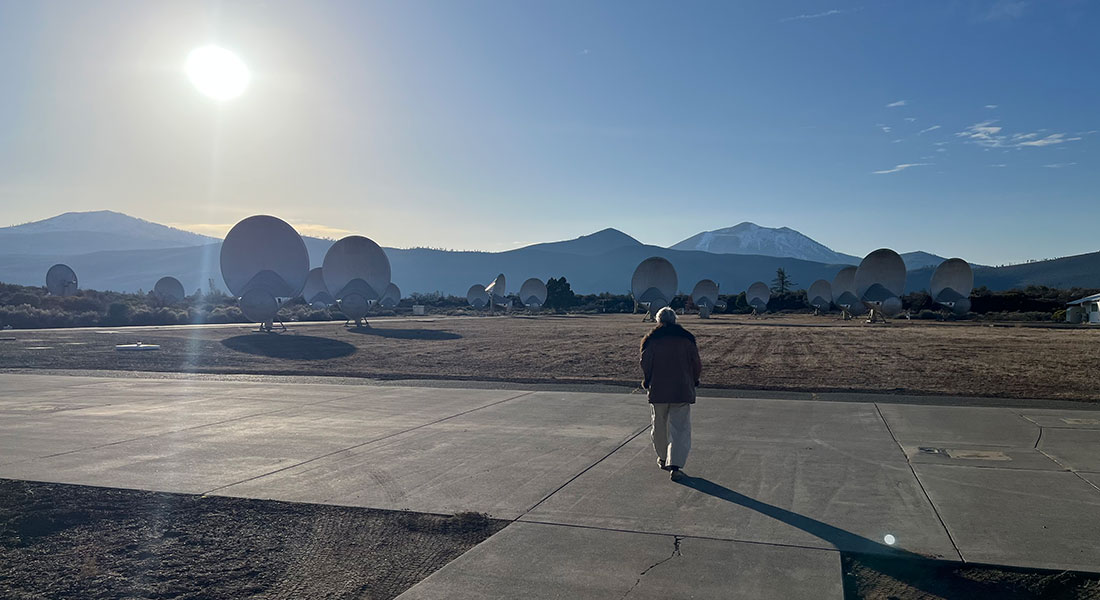
This presentation traces silica across its material continuum, from stellar nucleosynthesis to semiconductor. Through fieldwork at major observatories and an "intermaterial method", it surfaces material interconnections and operating assumptions embedded in technological infrastructures.
Silica is the residue of exploding stars, the sand beneath our feet, and the core material of the silicon chip driving Al. Its continuum from the cosmic to the computational is both metaphorical and material. What is revealed about the logic of technological acceleration when its core material is traced from supernova to silicon chip?
The research project We Are Supernova pursues this question through an "intermaterial method": using fieldwork and material investigation, from within art practice, to surface the compositional histories concealed within technology. This method develops, in part, through creative collaboration with scientists.
At Vera Rubin Observatory, Chile, surveying the southern sky in search of dark matter and cosmic transients, a drone was deployed to film its own reflection alongside the Rubin Observatory, in mirrors referencing the telescope mirror collecting light from the edge of the visible universe: technology reflecting technology in eternal self-referentiality.
At SETI's Hat Creek Observatory, listening for extraterrestrial communication, anything that doesn't resemble human-made technology is discarded as noise – the search for other intelligences is limited to our own reflection. Here, a filmed meditation session – a human antenna, was staged in a field of radio telescopes, while scientists animated them – a collaboration where the boundary between observation and performance was obscured.
Anne Haaning presents her postdoctoral project We Are Supernova, which explores the relationships between cosmological imaginaries, material processes, and human modes of life through artistic research. The research is conducted through an MSCA postdoctoral fellowship in the Department of Art at Goldsmiths University of London and will take the form of a live performed text alongside a video work enacting rather than reporting the intermaterial method.
Kayta Sander responds to the presentation from the perspective of her own practice and ongoing investigation of the relationships between digital technology, everyday life, and cultural imagination. The conversation is moderated by Eva la Cour.
Bios
Katya Sander
| Katya Sander is a visual artist with a special interest in conceptual and contextually based methods and processes. Her work is about production and circulation of social imaginaries: Structures, models and images through which we imagine ourselves and what we can do. She has was professor at the Royal Danish Art Academy, Head of Dept. for Language, Space and Scale, and is currently professor at Film Art School in Kabelvåg, UiT. |  |
Anne Haaning
| Anne Haaning is a visual artist currently based between London and Copenhagen. Haaning's practice is situated in the field of video and installation art with a strong focus on technology. She is a recipient of a Marie Curie postdoctoral fellowship, hosted at the Department of Art at Goldsmiths University of London, prior to which she defended her practice-based PhD at Oslo National Academy of the Arts in 2022. |  |
Eva la Cour
| Eva la Cour is a visual artist and postdoc at the University of Copenhagen’s Department of Art and Cultural Studies and the Center for Applied Ecological Thinking (CApE). Her practice combines academic research and process-oriented filmmaking to explore Arctic terrains with colonial histories, and their entanglement with ecological and social crises. |  |
Registration
Sign for the event! It is for everybody and it is free.
Artistic Practice as Applied Ecological Thinking
A conversation series at CApE in collaboration with INTERSECT
What is ecological thinking? What could it be? Could it be artistic practice?
CApE stands for the Centre for Applied Ecological Thinking. This conversation series explores how ecological thinking may be understood as something that is not merely applied to the world or translated into practice, but something that unfolds through practice itself. What possibilities for ecological thinking does artistic practice open up? And what forms and expressions of ecological thinking emerge in and through artistic processes?
The series takes its point of departure in specific contemporary art projects and artistic investigations. At each event, an invited visual artist or artistic researcher presents a current work in progress. The presentation is followed by a response from an invited respondent, who approaches the work from the perspective of their own practice, placing it in dialogue with broader artistic, research-oriented, and societal questions.
The series creates a space for discussing artistic works and processes and for exploring how artistic practices can function as sites of ecological inquiry and reflection. Each event consists of a presentation, a response, and an open conversation. The respondent is not invited to evaluate the work, but rather to enter into dialogue with it and unfold the questions it raises. In this way, the response constitutes a central element of the format.